
A multimodal group-based immersive virtual reality intervention for improving cognition and mental health in patients with post-covid-19 condition.
A quasi-experimental design study.
Principal investigators
Led by Dr. Maite Garolera and Dr. Bruno Porras-Garcia, alongside a multidisciplinary team including Neus Cano, Josep Gómez-Hernández, Mar Ariza, Toni Mora, and David Roche.
Participating institutions
The Consorci Sanitari de Terrassa (CST), the International University of Catalonia (UIC), and the University of Barcelona (UB).
Timeline and location
The study was conducted between March and August 2022, involving patients from 8 public primary care centers within the Consorci Sanitari de Terrassa (Barcelona, Spain).
Sample size
31 participants: 15 in the experimental group and 16 in the control group.
Publication
Published in the international scientific journal Frontiers in Psychology (Neuropsychology section) on July 25, 2024.
Technology used
Broomx Technologies’ MK360 immersive projector.
Context and intervention
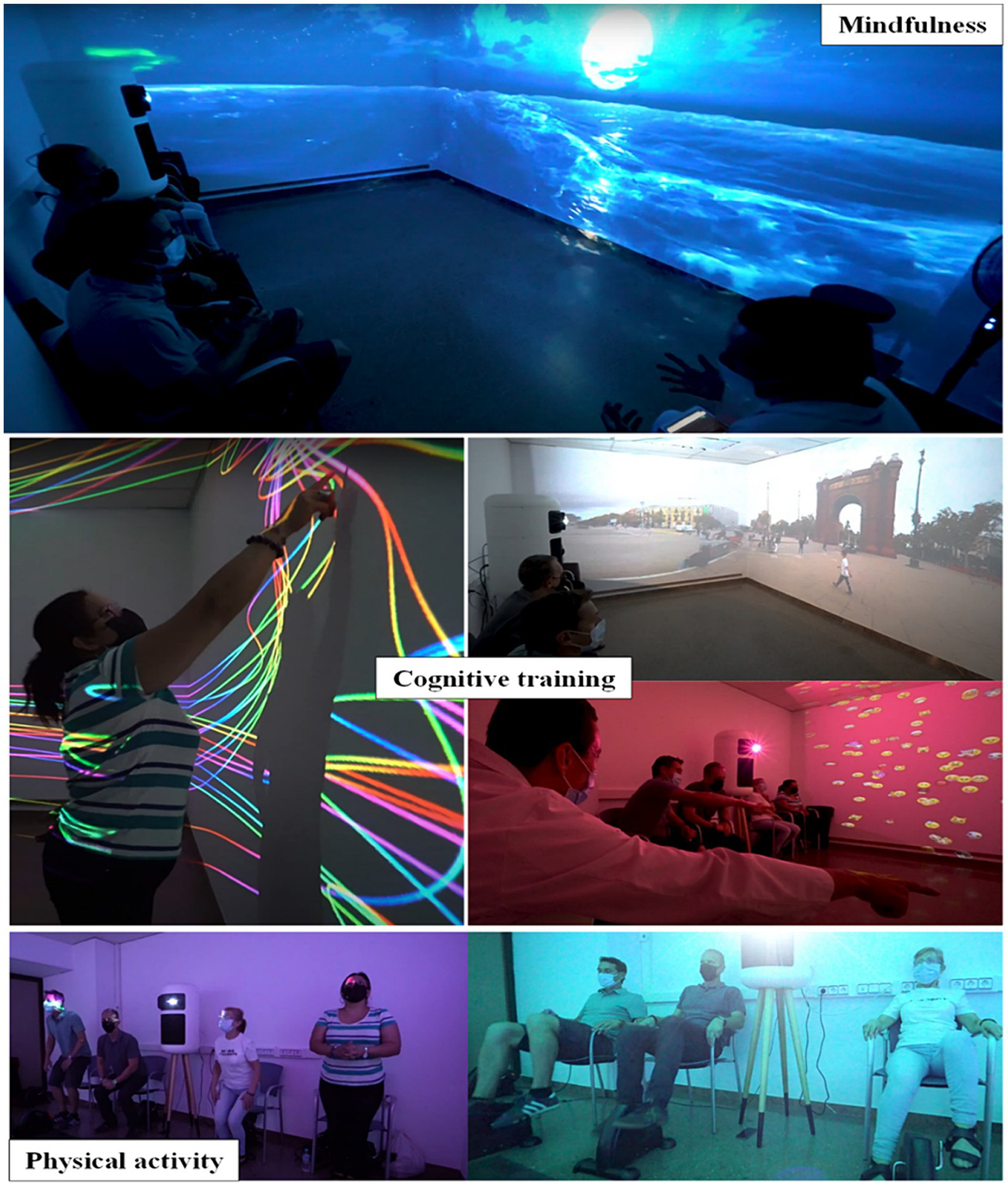
Between 10% and 15% of adults who recover from COVID-19 experience persistent symptoms, commonly known as “brain fog,” along with fatigue and depression. To address these cognitive impairments, a pioneering 8-week intervention was designed, combining cognitive training, physical exercise, and mindfulness.
By utilizing the Broomx MK360 projector, 31 patients (15 in the experimental group and 16 in the control group) were immersed in 360º virtual environments. This approach allowed for a shared, group experience—completely eliminating the need for VR headsets.

Context and intervention
Between 10% and 15% of adults who recover from COVID-19 experience persistent symptoms, commonly known as “brain fog,” along with fatigue and depression. To address these cognitive impairments, a pioneering 8-week intervention was designed, combining cognitive training, physical exercise, and mindfulness.
By utilizing the Broomx MK360 projector, 31 patients (15 in the experimental group and 16 in the control group) were immersed in 360º virtual environments. This approach allowed for a shared, group experience—completely eliminating the need for VR headsets.
Key results
- Reversal of cognitive impairment: The immersive group achieved statistically significant improvements in episodic memory, processing speed, and global cognition—gains that were not observed in the control group.
- Enhanced mental health: A clinically significant reduction in depressive symptoms was recorded, directly driven by the improvement in the patients’ cognitive abilities.
- High tolerability and engagement: Despite the intensive nature of the training, the experience did not cause fatigue (the patients’ most limiting symptom). Instead, it generated exceptionally high satisfaction levels that increased session after session, ensuring outstanding patient commitment.
Key results
- Reversal of cognitive impairment: The immersive group achieved statistically significant improvements in episodic memory, processing speed, and global cognition—gains that were not observed in the control group.
- Enhanced mental health: A clinically significant reduction in depressive symptoms was recorded, directly driven by the improvement in the patients’ cognitive abilities.
- High tolerability and engagement: Despite the intensive nature of the training, the experience did not cause fatigue (the patients’ most limiting symptom). Instead, it generated exceptionally high satisfaction levels that increased session after session, ensuring outstanding patient commitment.
Conclusions and discussion
This study marks the first successful trial to combine physical training, cognitive exercise, and mindfulness using immersive reality to treat Long COVID. The key to this success lies in the room-scale projection format (MK360), which eliminates common issues associated with VR headsets, such as motion sickness, isolation, or a sense of exclusion.
Instead, this format facilitated a group therapy dynamic that fostered cohesion, social motivation, and collaborative learning. Ultimately, this research represents a promising step forward for healthcare systems, proving that shared immersive reality is not only a viable and well-tolerated technology but also a powerful clinical tool for reversing complex neuropsychological and emotional impairments.

Conclusions and discussion
This study marks the first successful trial to combine physical training, cognitive exercise, and mindfulness using immersive reality to treat Long COVID. The key to this success lies in the room-scale projection format (MK360), which eliminates common issues associated with VR headsets, such as motion sickness, isolation, or a sense of exclusion.
Instead, this format facilitated a group therapy dynamic that fostered cohesion, social motivation, and collaborative learning. Ultimately, this research represents a promising step forward for healthcare systems, proving that shared immersive reality is not only a viable and well-tolerated technology but also a powerful clinical tool for reversing complex neuropsychological and emotional impairments.