
About Associació Esquitx
Based in the heart of Barcelona’s Sant Pere, Santa Caterina, and la Ribera neighborhoods, Associació Esquitx is a non-profit organization that has been dedicated to social justice and inclusion since 1985. Their team of 17 professionals and around 15 volunteers provides support to children, adolescents (ages 0–18), and their families, often those facing economic or social challenges.
What truly sets Esquitx apart is their neuroeducation-based methodology; they focus on emotional regulation and secure bonding as a foundation for growth. By integrating the Broomx immersive room into their center, they create safe, welcoming spaces where people can explore, learn, and simply feel better.

Promoting emotional and sensory well-being
As part of its work with children and families, Esquitx introduced new tools to support its educational and therapeutic activities. With the support of the Barça Foundation, through the Sport4all call, the organisation created an immersive reality room in one of its centres, equipped with immersive projection technology supplied by Broomx.
The immersive space
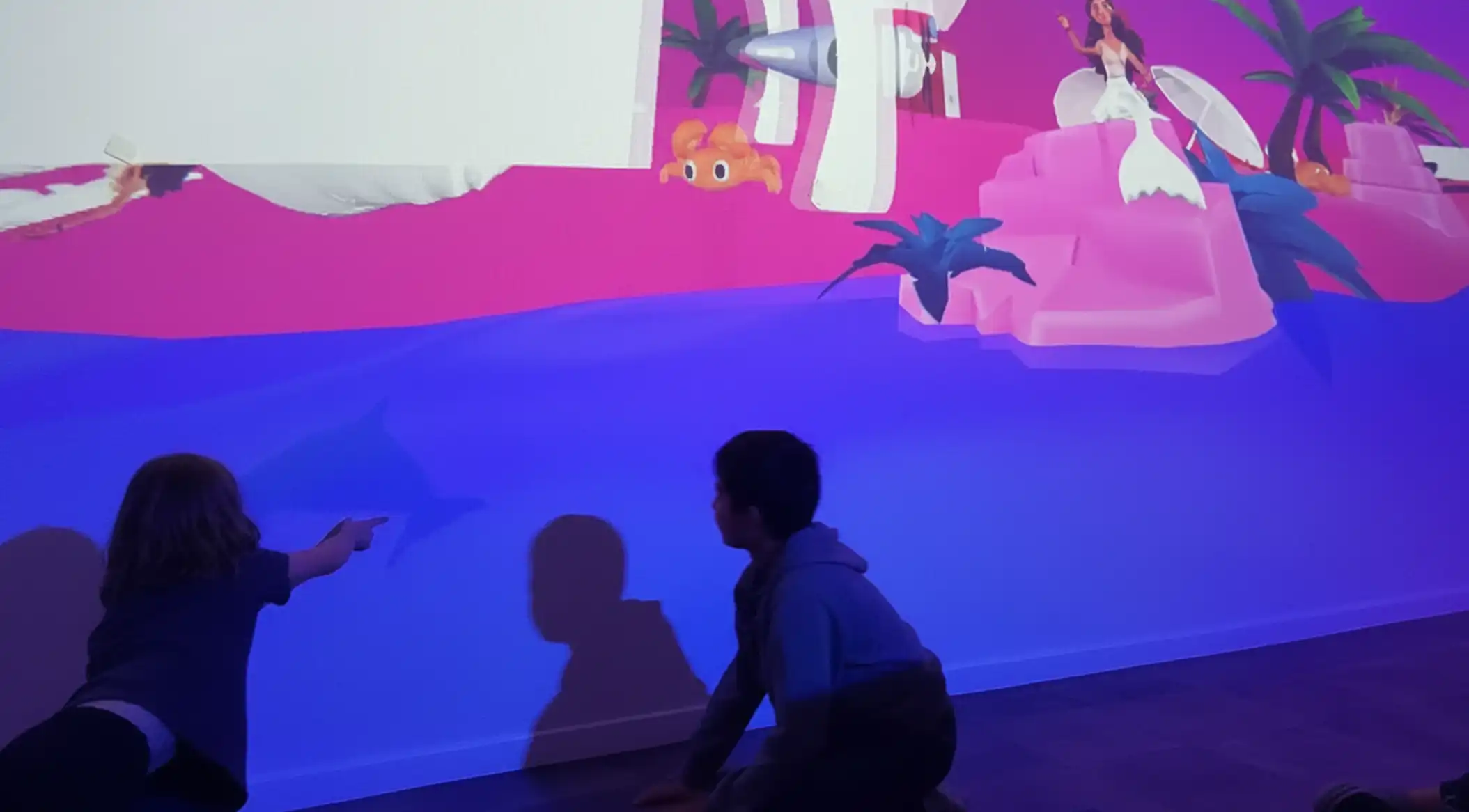
The immersive reality room features 180-degree visual projections across three walls and the ceiling, combined with surround sound. Some of the experiences also include interactive elements controlled via a tablet.
The room is designed to offer immersive and sensory experiences, where both children and adults can work on emotional, cognitive, and motor aspects of well-being.

The immersive space
The immersive reality room features 180-degree visual projections across three walls and the ceiling, combined with surround sound. Some of the experiences also include interactive elements controlled via a tablet.
The room is designed to offer immersive and sensory experiences, where both children and adults can work on emotional, cognitive, and motor aspects of well-being.
Tailored sessions for children, families, and adults
Children from the Open Centre and families taking part in the Family Support (S.O.A.F.) programme have already begun using the immersive room. With children, we are exploring ways to better regulate activation levels, which can sometimes be very high, and to structure access individually or in small groups of four or five. We aim to implement a simple evaluation system using emoticons, complemented by a professional observational assessment conducted afterwards within the framework of the Open Centre activities.
For adults and family groups, the sessions are adapted to focus more on therapeutic support and stress reduction.

Tailored sessions for children, families, and adults
Children from the Open Centre and families taking part in the Family Support (S.O.A.F.) programme have already begun using the immersive room. With children, we are exploring ways to better regulate activation levels, which can sometimes be very high, and to structure access individually or in small groups of four or five. We aim to implement a simple evaluation system using emoticons, complemented by a professional observational assessment conducted afterwards within the framework of the Open Centre activities.
For adults and family groups, the sessions are adapted to focus more on therapeutic support and stress reduction.
With families, sessions focus on emotional and body awareness as well as mindfulness. At the end of each session, women are given a drawing of a human silhouette to color and use to represent the changes they have experienced. Qualitative feedback is also collected. They greatly value this safe space to reduce stress and to “step outside” the neighborhood while taking part in sessions that enhance their wellbeing. The sessions are facilitated by the organization’s psychologists.
During the 2023–2024 academic year, pilot sessions were carried out to evaluate and refine the intervention.
Collaboration with Broomx
Broomx participated in the project as a technology partner, supplying the projection system and supporting the initiative by organising a working group with health and social centers already using immersive technology in their interventions. These sessions focused on sharing practical cases, exchanging experiences, and defining indicators to help record and evaluate results.